
Standard 01
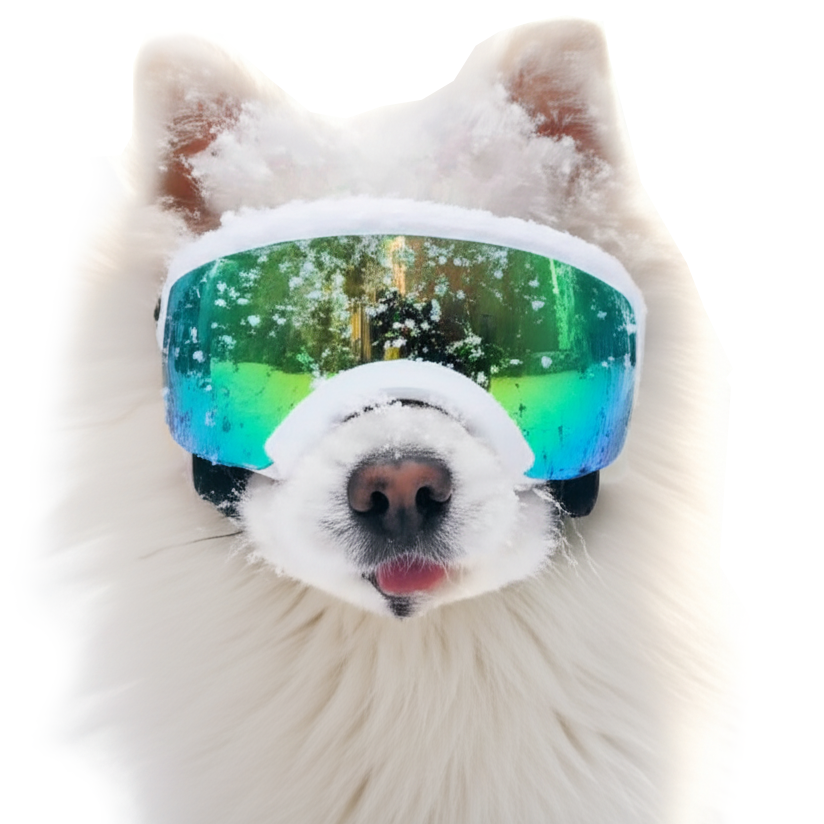
Kyunglas — Color Set
$129.95

Kyunglas — Color Set
$129.95
KYUNGLAS COLOR
Dogs Face More Glare Than You Think
UV and glare protection for daytime walks.
UV Protection 99.9%Glare ReductionDaytime Lens
★ 4.8 · 1,200+ reviews
·
Fitted on 1,000+ real dogs
·
2.5+ years development
Every Walk Over 20 Minutes Adds Up.
Low Eye LevelSkyward GazeBright PavementAging Iris ControlLong WalksStrong Sun
Dogs look up at the sky and at us from a much lower angle than we do — so on sunny walks, their eyes take in more glare than ours. As dogs get older, the iris often controls light less precisely too, so squinting becomes more common, even in otherwise healthy dogs.
When Color Makes Sense
Built for Bright, Sunny Days
Walks Over 20 Min
Parks & Open Trails
Bright, Open Ground
Beach & Bright Sand
Cycling in Strong Sun
Color Lens is designed for UV and glare protection on daytime walks over 20 minutes in strong sun — it isn't a night lens. Dogs with noticeable light sensitivity, an eye condition, or weaker pupil control benefit the most, but any dog on a long sunny walk is exposed to more glare than you'd expect.
“Tinted goggles wouldn't be a good choice on evening walks or doing search and rescue in the dark.”
— Dr. Marnie Ford, DVM, DACVO (board-certified veterinary ophthalmologist)That's why Color is built for daytime glare, and Clear — not a dark lens — is the one made for evening walks.
The Color Lens Promise
Protects Their Eyes When the Sun Gets Strong
Glare Reduction
Mirrored tint softens the intensity of bright, reflected light — not by blocking everything, but by cutting down what gets through.
UV Protection 99.9%
Blocks 99.9% UVA/UVB/UVC, built into the lens material itself — the same standard as every Kyunglas lens.
Daytime, Not Darkness
Built to handle strong sun, not to replace a clear lens after dark. Pair with Clear for full-day coverage.
The Kyunglas Standard
What Makes a Good Tinted Lens?
Good Lens Standard 01
Brightness Is What Matters, Not Color.
A tinted lens shouldn't be chosen by color alone — what actually matters is how much light it lets through.
Why are there seven lens colors?
Most Kyunglas color lenses use a near-neutral tint — the mirror coating changes how the lens looks from the outside, but what your dog actually sees through it stays close to natural. The real difference between colors is brightness, measured as VLT (Visible Light Transmission): how much light passes through the lens.
| Lens Color | VLT | Brightness |
|---|---|---|
| Red | 28.9% | CAT2 — Lighter |
| Smoke | 26.6% | CAT2 — Lighter |
| Purple | 23.8% | CAT2 — Lighter |
| Tulip Purple | 21.2% | CAT2 — Lighter |
| Gold | 18.2% | CAT2 — Lighter |
| Green | 16% | CAT3 — Darker |
| Blue | 14.6% | CAT3 — Darker |
CAT2 — Lighter
CAT3 — Darker
Choose by how strong the sunlight is where you walk — not by which color looks best.
Small and Medium offer all 4 frame colors and all 7 lens colors. Large is available in White, Black, and Pink frames, and Tulip Purple replaces the standard Purple lens option.
Good Lens Standard 02
Performance Should Be Proven.
A good lens shouldn't be judged by a single test. Real protection has to perform under more than one condition.
Vision
UV Cut 400
UVA/UVB/UVC
Pass
Distortion
Center-line check
Pass
Surface Performance
Anti-Fog
Fog resistance
Pass
Hard Coat
Scratch resistance
Pass
Impact
High-Velocity
250 ft/s (~274 km/h)
Pass
High-Mass
500g / 1.3m drop
Pass
Environmental Durability
High Temp
+70°C, 6h
Pass
Low Temp
−25°C, 6h
Pass
Aging
Long-term stability
Pass
Storage
Material stability
Pass
Built on the ANSI criteria used for human protective eyewear and goggles — and tested even more rigorously across all 10 categories above.
1,000+dogs fitted
2.5 years+field-tested
Realenvironments
A Dog's Face Isn't Flat.
Dog faces vary widely in width, muzzle length, and contour. That's why fit can't be solved with straps alone.
3 SizesAdjustable Strap7-Point FitFace-Contour Design
Find Your Dog's Fit.
Head circumference — quick guide, no guesswork.
SSmall
MMedium
LLarge
| Size | Head Circumference |
|---|---|
| S | 22–29cm / 8.7–11.4" |
| M | 30–38cm / 11.8–15.0" |
| L | 39–46cm / 15.4–18.1" |
Measure head circumference between the eyebrows and ears, closer to the eyebrows, using a soft tape measure.
Falling within a size range is a starting point — fit can still vary by eye spacing and muzzle shape.
Small and Medium offer all 4 frame colors and all 7 lens colors. Large is available in White, Black, and Pink frames, and Tulip Purple replaces the standard Purple lens option.
7 Lens Colors — Choose by Brightness
Red
Smoke
Purple
Tulip Purple
Gold
Green
Blue
Getting Used to Kyunglas
New gear takes time, and adjustment varies by dog.
Short indoor sessions
Pair with treats
Positive association
Link to a walk they love
Which Lens Matches Your Dog's Day?
Clear
Best forNight walks, adaptation period, rainy days
UV block99.9% UVA/UVB/UVC
TintNone — natural vision
Why at nightProtects eyes from branches and debris while sniffing in the dark, and reduces irritation from fine dust
Color
Best forDaytime walks, 20+ min in strong sun
UV block99.9% UVA/UVB/UVC
TintMirrored — reduces glare
Night useNot recommended — switch to Clear after dark
Active
Best forDay & night, no lens swapping
UV block99.9% UVA/UVB/UVC
TintPhotochromic — clear to smoke, adapts automatically
Night useYes
Active Pro
Best forDay & night, with mirror finish
UV block99.9% UVA/UVB/UVC
TintPhotochromic — clear to smoke, rose-gold mirror
Night useYes
Clear and Color aren't a lower tier and a higher tier — worn together, they keep their eyes comfortable from morning to night.
Frequently Asked Questions
Can my dog wear Color lenses at night?
No — Color lenses reduce UV and glare during the day, which also makes them darker at night. Switch to Clear after dark, or choose the Clear + Color set to swap easily.
How is the Clear + Color set meant to be used?
Use Clear for night walks, the first adjustment period, and rainy days — it protects their eyes from branches and debris while sniffing in the dark, and reduces irritation from fine dust. Switch to Color for daytime walks over 20 minutes, when UV and glare are strongest.
Why are there seven lens colors, and how do I choose?
Choose based on brightness, not color. Each lens has a VLT (Visible Light Transmission) rating — the lower the number, the darker the lens. Gold, Tulip Purple, Purple, Smoke, and Red sit in the CAT2 range (lighter); Green and Blue sit in CAT3 (darker). In stronger sunlight, a CAT3 lens is a good default.
Does the lens color change what my dog sees?
Not the way it looks from the outside. Most Kyunglas color lenses transmit light in a near-neutral tone, so the view through the lens stays close to natural — brightness is what changes, not color.
Are all frame and lens colors available in every size?
Small and Medium offer all 4 frame colors and all 7 lens colors. Large is available in White, Black, and Pink frames, and Tulip Purple replaces the standard Purple lens option.
Does Color block UV the same as Clear?
Yes — 99.9% UVA, UVB, and UVC, built into the lens material itself, the same as every Kyunglas lens.
Worldwide ShippingTo most countries
Size / Return SupportFit guidance before & after
Customer SupportReal answers, real people
Ready for Sunny Days Ahead?
Daytime UV and glare protection — pair with Clear for round-the-clock eye comfort.
Choose Your Color